
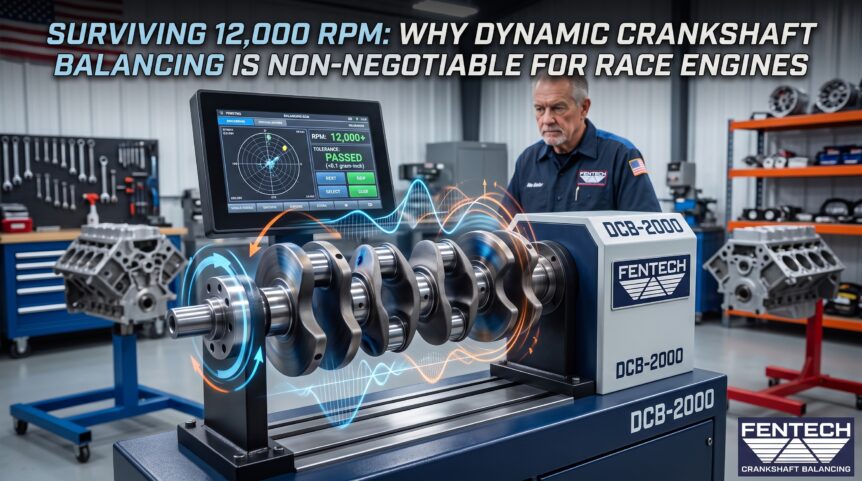
When you’re pushing a race engine past the 10,000 RPM threshold, you aren’t just fighting the competition—you’re fighting physics. At 12,000 RPM, the centrifugal forces acting on a rotating assembly increase exponentially. A crankshaft that feels “smooth enough” for a street build becomes a ticking time bomb on the track if dynamic balancing isn’t dialed in to absolute perfection.
For professional engine builders, achieving zero-tolerance rotational harmony isn’t just about reducing vibration; it’s about unlocking trapped horsepower, eliminating parasitic power loss, and keeping the rotating assembly inside the block where it belongs.
The Physics of High-RPM Torsional Vibration
Every gram of unbalance in a rotating crankshaft generates a centrifugal force that pulls the crank off its true center of rotation. At low RPMs, the heavy cast-iron blocks and fluid dampers can mask this oscillation. But as you climb toward the 12,000 RPM mark, that minute rotational mass inconsistency multiplies violently, inducing severe torsional vibration.
This vibration acts as a massive parasitic drain. Instead of your combustion energy being transferred linearly into torque and horsepower at the flywheel, a percentage of that energy is wasted simply trying to muscle a vibrating, flexing piece of forged steel through its rotation. If you want to maximize your high-RPM horsepower, you have to eliminate the mechanical drag caused by an unbalanced crank.
Protecting the Hydrodynamic Oil Film
Torsional vibration doesn’t just steal horsepower; it murders bearings. High-revving engines rely on a microscopically thin hydrodynamic oil film to keep the main and rod journals from contacting the bearing shells.
When an unbalanced crankshaft reaches high speeds, the resulting micro-deflections cause the journals to literally hammer through that oil film. Once metal touches metal, temperatures spike, bearings wipe, and the engine is done for the weekend. Achieving aerospace-level tolerances in your rotating assembly is the only way to maintain perfect bearing clearances under extreme stress.
(For a deeper dive into the relationship between RPM, stress, and bearing survival, check out Engine Builder Magazine’s technical breakdown on performance bearing clearances.)
The Fentech DCB-2000 Advantage
You can’t achieve race-winning results with outdated analog equipment. The Fentech DCB-2000
is engineered specifically for the precision demands of high-performance machine shops and professional engine rebuilders. It bridges the gap between raw mechanical engineering and user-friendly digital operation.
When you chuck a crank into the DCB-2000, you are getting:
- Aerospace-Level Precision: Advanced sensors detect the most minute weight variances, allowing you to drill or add heavy metal with absolute confidence.
- User-Friendly Digital Controls: Our modern touchscreen interface eliminates the guesswork, calculating exactly where and how much weight needs to be adjusted in seconds.
- Massive Structural Durability: Built on a heavy-duty frame to eliminate external shop resonance, ensuring your readings are perfectly isolated.
- Ironclad Protection: Backed by our industry-leading “Made in the USA” warranty, ensuring this machine performs flawlessly for decades.
Stop Leaving Horsepower on the Table
In professional racing, close enough is a guaranteed DNF. Bring aerospace-level precision to your machine shop with the DCB-2000 and ensure your engines survive the back straightaway.
Ready to upgrade your shop’s capabilities? Submit your shop specs via our online form to connect with our technical sales team today.
Crank It Up!