
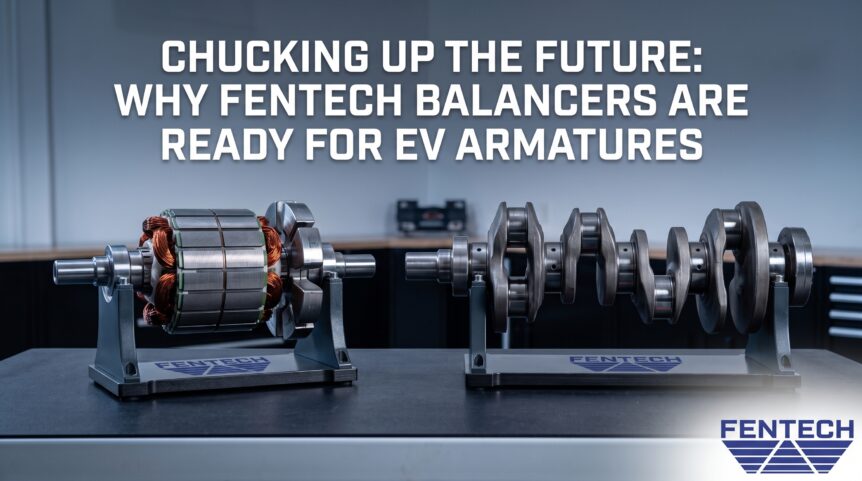
The performance machining world is evolving. While we’ll always love the ground-pounding torque of a stroked Big Block Chevy, the reality of the modern shop floor is shifting. Today, you’re just as likely to see a permanent magnet synchronous motor (PMSM) from a Tesla drive unit sitting on the bench next to a billet LS crank.
But here’s the unshakeable law of physics: rotational mass is still rotational mass. Whether it’s surviving 9,000 RPM at the drag strip or whining out to 18,000+ RPM on the highway, dynamic balancing is the only thing standing between smooth-running efficiency and catastrophic bearing failure.
Here is why Fentech balancers—specifically the rugged architecture of the DCB-750—are perfectly engineered to handle the unique dynamic balancing needs of EV armatures without a massive learning curve.
The Anatomy of an EV Armature vs. an ICE Crankshaft
Balancing a traditional ICE crankshaft is all about managing reciprocating weight—accounting for pistons, rings, rods, and wrist pins through precise bobweights. EV motor shafts, however, are an entirely different beast.
EV armatures and rotors have vastly different weight distributions and magnetic characteristics compared to traditional cast or billet cranks. They don’t require bobweights, but they operate at significantly higher RPMs. Any microscopic imbalance in a rotor spinning at 15,000 RPM creates extreme torsional vibration, leading to high-frequency bearing wear, heat generation, and a massive drop in motor efficiency.
To dig deeper into the specific assembly and balancing physics of modern EV motors, check out this comprehensive breakdown on [PMSM assembly and balancing requirements].
Enter the DCB-750: Rigidity Meets Digital Precision
To handle EV armatures, your machine needs absolute mechanical rigidity combined with high-precision sensor technology. A flimsy balancer bed will mask the high-frequency vibrations of an EV rotor, leading to false reads and chased weights.
The Fentech DCB-750 is built differently. Its heavy-duty, Made-in-the-USA architecture provides a rock-solid foundation that isolates true imbalance from environmental noise, ensuring absolute precision whether you are drilling a crank counterweight or adding epoxy to a rotor.
Key Technical Advantages for EV Balancing:
- Extreme Sensitivity: Advanced sensor arrays detect imbalance down to a fraction of a gram-inch, guaranteeing the tight tolerances required for 15,000+ RPM electric motors.
- User-Friendly Digital Controls: Switch seamlessly between standard crankshaft profiles and cylindrical EV rotors. Our touchscreen interface calculates exactly where and how much weight needs to be added or removed, minimizing operator guesswork.
- Rugged Versatility: The hard-bearing suspension design accommodates everything from lightweight EV rotors to massive diesel cranks without requiring complex recalibration between jobs.
- Bulletproof Reliability: Backed by our industry-leading [Made in the USA Warranty], ensuring your shop stays running shift after shift.
Future-Proof Your Shop Floor
You don’t need two different machines to handle the past and the future of horsepower. You need one piece of equipment with the rigidity to handle heavy iron and the digital precision to dial in high-tech armatures. Fentech bridges the gap, maximizing shop efficiency and expanding your capabilities.
Need a balancer that handles Big Block Chevys on Monday and Tesla drive units on Tuesday? Explore the DCB-750 specifications and bring absolute precision to your shop floor.
Crank It Up!