
Look, we spend a ton of time in this shop talking about keeping high-strung race cranks alive past 10,000 RPM. When a race engine builder is chasing high-RPM horsepower, precise dynamic balancing is exactly what separates a podium finish from a windowed block. But the brutal physics of rotational mass don’t change just because you swap a screaming track V8 for a massive marine diesel engine or a high-flow industrial plant pump.
Whether you’re trying to win races or keep an industrial plant online 24/7, it all comes down to killing torsional vibration and managing rotational forces before they hammer your bearings to dust. Today, we’re stepping off the track to look at the heavy hitters. We are decoding ISO 21940 —the global benchmark for rotor balancing—to understand exactly what balance quality grade your heavy equipment actually needs.
The Global Benchmark: The Physics of ISO 21940
At its core, ISO 21940 uses a “G-grade” to classify the permissible vibration velocity of a rotating assembly in millimeters per second (mm/s). It is not just an arbitrary chart; it is a mathematically founded standard that ties permissible unbalance directly to a rotor’s mass and its operating speed.
To figure out your permissible residual unbalance, you have to run the math:
| Uper = | 9549 × G × M |
| RPM |
Where:
- Uper = Permissible residual unbalance (g·mm)
- G = Balance quality grade (mm/s)
- M = Rotor mass (kg)
- RPM = Maximum service speed
G6.3 vs. G1600/G4000: The Tale of Two Tolerances
Understanding how that formula applies on the shop floor is critical for machine efficiency. Let’s look at opposite ends of the industrial spectrum.
G6.3: The Standard for Industrial Pumps and Fans
For standard industrial rotating equipment like centrifugal pumps, blowers, and electric motors operating between 1,500 and 3,600 RPM, G6.3 is the universal sweet spot. These machines require tight tolerances to minimize torsional vibration over thousands of hours of continuous duty. Hitting a G6.3 grade ensures the rotor runs smoothly within its designed bearing load, directly extending equipment service life.
G1600 and G4000: Massive Marine Diesels
Now, let’s talk about the real heavyweights. When you are dealing with the crankshaft drives of slow-running, two-stroke marine diesel engines, you step into the G1600 and G4000 territory. Why such a massive G-number? These engines feature extreme rotational mass but operate at exceptionally low piston speeds—often below 9 m/s.
Because centrifugal force rises with the square of speed, a slow-turning marine crank can safely tolerate a massively higher residual unbalance than a race crank turning 12,000 RPM.G1600 applies to inherently balanced large marine cranks, while G4000 is reserved for inherently unbalanced, rigidly mounted marine diesel drives.
Why Tighter Isn’t Always Better
A rookie mistake in the shop is demanding a G1.0 or G2.5 precision grade for a standard water pump impeller. Over-specifying your tolerances exponentially increases shop time and balancing effort without delivering any measurable improvement in performance or bearing longevity.
On the flip side, under-specifying is catastrophic. Slapping a G16 grade on an electric motor that requires G6.3 guarantees the dynamic forces will rip the bearings apart before the warranty expires. You have to match the standard to the exact RPM and rotational mass of the application.
The Fentech Advantage: Dialing in Precision
Hitting exact ISO tolerances without wasting shop hours requires having the right iron on your floor. Whether you are dialing in a G2.5 precision race crank or managing the heavy rotational mass of a G6.3 industrial pump rotor, Fentech’s balancing machines take the guesswork out of the physics.
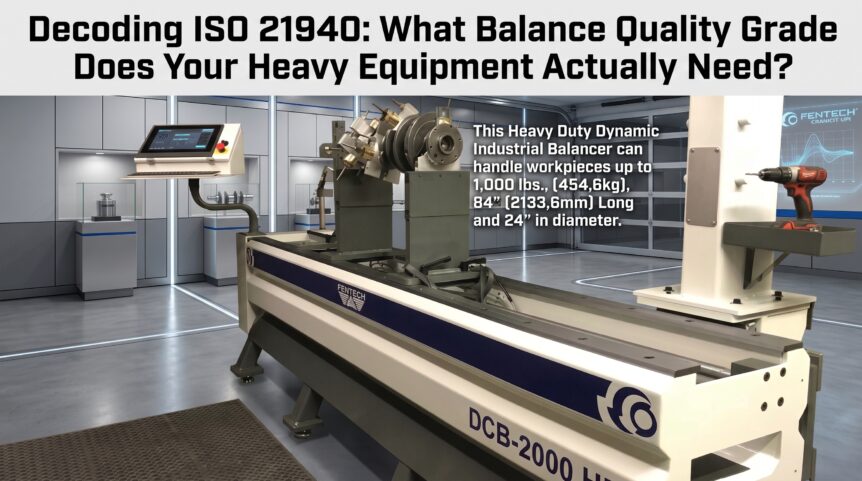
- Massive Capacity: Our Fentech DCB-2000 Heavy-Duty Balancer and DCB-750 are engineered to easily handle heavy industrial components and massive rotational mass while maintaining aerospace-level precision.
- User-Friendly Digital Controls: Fentech’s intuitive software does the heavy lifting, automatically crunching the ISO 21940 math and calculating exact correction weights and angles so your operators can work faster and smarter.
- Bulletproof Durability: Built for the harshest machine shop environments to deliver repeatable, dead-on accuracy shift after shift.
- Ironclad Warranty: Every Fentech machine is backed by our rock-solid “Made in the USA” warranty, ensuring you’re never left hanging when production is on the line.
Stop throwing shop hours at arbitrary balancing targets and start machining with purpose. Equip your shop with the technology to hit exact ISO 21940 tolerances with absolute confidence.
Crank It Up!